Expert led AI

I’m on the record as being - at least as of a few years ago - something of a sceptic when it comes to AI. Put it down to years and years of breakthroughs that threatened to transform the world - everything from Web3 to Blockchain to VR to Crypto - only for that potential to mostly fizzle out. My scepticism has served me pretty well over the years, especially as a delivery guy who needs to see through the hype to work out, and be on the hook for, something that can actually be delivered, and which then meets business needs. A quick glance at the Gartner hype cycle from 2020 is quite a sobering exercise (lol, “Explainable AI”), and as recently as 2023, the outputs from AI were questionable in some cases, laughable in others, and downright dangerous on occasion.
But I have to admit that AI has come on leaps and bounds in the last few years, and it’s now transforming every sector under the sun in many ways, both good and bad. My scepticism remains healthy, and I would tend to agree with Daniel Jalkut when he says that “everybody who’s against it is too against it and everybody who’s for it is too for it”. Lots of people are talking past each other. Regardless, having now seen many results first hand, I’m of the view that people in our industry can’t afford to sit this out, at least if they want to stay employable in the long term.
We can’t ignore the societal and environmental impact, though. One could argue the disruption on our working classes will be just as significant as the Industrial Revolution, or the advent of the internet itself. But if I’m right, and AI isn’t going away (I am right), then the smart move is to figure out how to adapt to the new reality while still advocating for the negative impacts to be addressed as a priority.
I’ve been lucky enough to work with some of the most talented designers and developers in the world. It’s painful to watch AI disrupting our jobs and careers, and emotions understandably run high when your source of income and ability to support your family is under threat. But my view is that, if you’re good, then the things that make you good are still essential for successful projects. AI can’t do brilliant work on its own, because brilliant work isn’t derivative - and that’s what AI specialises in. From my experience it still needs a strong and experienced hand to push it in the right direction. I’ll flesh that out below.
The definition of AI remains as nebulous as ever. But for the purpose of this post, let’s assume it’s the kind of thing the three leading AI platforms are capable of. My opinion is largely driven by my recent experience building a fully autonomous AI-developed, agentic-driven business, which at the time of writing is maybe a month from launch. It’s a marketplace SaaS platform, designed using Figma agents, and built using a combination of ChatGPT (for defining and enshrining business context) and Codex (the desktop app for ChatGPT), with no outside human help. From a spec perspective, it includes everything you’d expect in a well established modern platform:
- Full CI/CD pipeline, including fully configured dev, staging and production environment
- Extensive regression test harness that runs at build time (80% coverage)
- Automated dependency review and upgrade
- Careful cost management (if the resulting business is profitable, it’ll be partly because running costs are so low)
- Accessibility compliant, cross browser tested, fully responsive and performant front end (100% Lighthouse scores across the board)
- CDN architecture ensuring lightening fast page load times
- Integration with Firebase for auth, Social sign in (Google and Facebook), Google Analytics, Stripe, Postmark and more
- Infrastructure as Code - rapid Disaster Recovery model, including database backups
- Complex workflows including an extensive administration portal
And much more. All tested, all working. It’s taken me 2 months so far, maybe 2 days per week, with about a month to go, and that’s cost me about $200 in software costs. I’ve planned and costed up many similar projects in the past, and I would probably have charged around $400k to build this with humans, maybe a six month project. It simply wouldn’t have been possible without AI, I just don’t have the time, money or skills.
Is the code garbage, under the hood? Is it maintainable? Honestly, I don’t know - I’m not qualified to pass judgement. And who knows, maybe a future dependency update will bring the whole thing down like a house of cards. But, right now, I can’t see any issues from looking at the user interface, or from my fairly extensive testing. That alone speaks volumes.
I’ve been reflecting on this image shared in a previous blog post:
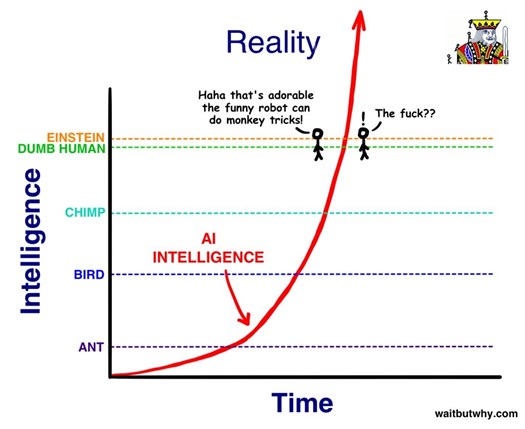
This is no longer a helpful way to look at AI. The line in the diagram is really referring to AGI - Artificial General Intelligence, where AI can outsmart humans across the board - and from where I’m standing we are nowhere near that point. AI can sometimes give the impression that it’s intelligent, but under the hood it’s just a probabilistic pattern matching machine - and this will be its limitation for a good while yet. But what if you’re doing things where a probabilistic pattern matching machine is helpful? The reality is that you need to look at different use cases to understand how and when AI can help you get the outcome you’re looking for - and when it can’t. This is a vital step in determining your strategy for bringing AI into the workplace.
Which brings me onto the point I’d like to make. Everyone has a hot take on AI, but I’d like to frame up my perspective with an important question which I think is worth asking whenever we consider the role that AI might play in a business.
How useful is pattern matching or repetition in your chosen task?
Really, I think this is the big one. Let’s look at a few examples:
Coding
From my experience above, I would say that the parameters of my project made it a good candidate for using AI. The platform itself isn’t hugely complex or innovative (unlike the business model, which I think might have some juice). Plus it was a greenfield project, where every single line of code was going to be written by AI. I provided significant guidance along the way which was captured in an operating model, laying contextual foundations for current and future AI agents as we went. If this was a far more complex project, or we were dealing with a legacy codebase, I would be very apprehensive about throwing a probabilistic pattern matching machine at it - especially without a very seasoned developer to oversee the work. I think there’s still a decent chance I’ll hit a ceiling where adding more complexity to my platform results in cascading failures that I can’t get it to fix. But I’m not there yet.
Design
Again, from my experience above, I’d say my project was a good candidate. The user interface uses well established interaction patterns (and publicly available codebases to view source), and that meant the Figma to Codex workflow could be successful. If we were trying to crack a really complex or innovative user experience challenge, involving research and hypothesis and testing, I doubt AI would’ve performed half as well. In fact I asked Figma to create multiple design routes for exploration, and many of them were garbage (and the good ones were very similar to each other). In summary, the Figma agent performed ok, but I’m not convinced it would handle a complex project as well.
Strategy
I’ve used AI to help with some of my strategy projects, and I’ve found it very helpful at finding good sources for research, and opening up interesting lines of enquiry I might not otherwise have considered. But it took my lived experience and judgement, combined with deep, complex collaboration with my clients, to make the strategy competitive and actionable. AI can’t understand and balance budgets and trade-offs and opportunities and risks as well as a human. Just because AI can produce a strategy document that looks compelling at first glance, doesn’t mean it’s going to work. Because it’s a probabilistic pattern matching machine, it’s going to be based on similar companies with similar strategies, and is therefore unlikely to give you the advantage you’re looking for. Even if you then steer it away from the average, it’s still going to be anchored there.
Content
Obviously this is a contentious topic, as it’s now ridiculously easy to generate huge quantities of content with a single prompt. And the slop is now feeding the slop, with AI spiders crawling through content created by AI to “evolve” it’s models. Viewed through the lens of pattern matching, this content stands a high risk of being highly derivative. But when an expert steers it in the right way, it can become…maybe good enough? For example, an expert might provide context around desired tone of voice, carefully compose the prompt with their explicit point of view, maybe write some of the content herself, direct the AI assistant towards specific sources, and then pore over the work afterwards to tighten it up. Is this as good as it being written explicitly by a human? Probably not, but it’s getting closer - and perhaps the time and cost saved are making the trade off worthwhile in some circumstances. Got a great example - one of my friends has been job hunting, and would spend hours findings potential jobs and tailoring resumes and covering letters for his application. Hugely time consuming and frustrating as he hardly ever heard back. But he followed the above process (including providing chunks of boilerplate content as a source) and he found jobs he might not otherwise have found, saved hours every day, had full ownership over the output, was able to cast a wider net, and has just landed a job.
I wrote this post entirely by hand, by the way! I enjoy writing and I find the process of composing a post helps me sharpen up my point of view. Hopefully it’s more lucid and enjoyable to read as well?
If your tolerance for failure is very low - say in the healthcare and legal professions - that just means more expertise and diligence is needed. Maybe the benefits of AI are lower, but they could still remain. White collar workers - especially younger ones - owe it to themselves to find out. Older ones might just make it to retirement…
To what extent are you willing or able to lead the AI assistant?
Your level of experience and expertise is likely to determine your success rate. And this is where my aforementioned expert colleagues come in. The things that make you good and the aspects of the job that are enjoyable are still needed - AI has mostly taken away the boring repetitive stuff. For example, I’m not a developer or a designer, but I’ve worked with them for 30 years and now understand some of the big decisions that are being made and the implications of those decisions, and that fed directly into my question and answer sessions with Codex. A real expert would’ve fared even better and been even more productive.
On the other hand, if you’re not an expert in an area you’re exploring, the pattern matching machine will get you going quite quickly - but it’s likely to make a lot of decisions that you don’t understand and which collectively act like an anchor on your project. I would venture that many vibe coders are finding this out the hard way. I’m acutely aware that I might too.
We still have to grapple with the fact that ignorant leaders will try and get along without this expertise. But as always, the good will distinguish themselves from the less good, and we’ll all get better at spotting snake oil when we see it.
Side note: I find it worrying but also interesting that many people are relying on AI assistants for health related matters, including mental health. This seems incredibly risky at first glance, but when we look at mental health issues through the pattern matching lens, and given that professional advice is unaffordable for some, maybe there’s some value in the breadth of experience that an AI assistant can access that makes it worthwhile? The sycophantic nature of these assistants is definitely a problem when it comes to mental health, especially as it veers between messy relationships and the repercussions, but potentially that’s solvable through legislation. It’s early days, after all. Likewise if the condition itself is potentially serious, legislation can ensure that the assistants direct the patient to get the help they need. Now, if we could only find some brave, intelligent leaders to lead the charge…
In summary, I believe that every industry is already splitting into two streams - companies that have committed to figuring out how AI should be leveraged, and those that will find themselves gradually falling behind. But there remains an important caveat - the companies that are mandating that AI should be used extensively across the business, without leaders properly understanding the above implications, are likely steering their ships towards the iceberg. Prudent scepticism and thoughtful application remains the order of the day.